On any construction site, reliable power is the backbone of productivity and efficiency. Whether you’re running high-draw power tools like saws, welders, and air compressors, illuminating work areas, or powering a temporary office, a heavy-duty portable generator is an indispensable asset. As an experienced technician, I understand the critical role these machines play in keeping projects on schedule and ensuring seamless operations. This comprehensive guide will help you navigate the complexities of selecting, using, and maintaining the ideal portable generator to meet the rigorous demands of your job site.
What Are Heavy Duty Portable Generators? (Definition and Applications)
Heavy duty portable generators are robust power sources specifically engineered to withstand the harsh conditions and continuous demands of professional work environments like construction sites, industrial facilities, and remote job locations. Unlike standard home backup generators, these units are built with enhanced durability, higher power output, and specialized features tailored for contractor-grade equipment. They are designed to deliver consistent, reliable electricity for extended periods, making them crucial for uninterrupted workflow.
There are primarily two types often considered:
- Conventional (Open-Frame) Generators: These are the traditional workhorses, known for their high power output and rugged construction. They are typically louder but excel at powering multiple heavy-duty tools simultaneously.
- Inverter Generators: While generally quieter and providing cleaner power suitable for sensitive electronics, larger inverter models are emerging that can handle more substantial loads, offering a blend of quiet operation and moderate power for specific job site needs.
Heavy duty portable generators find extensive applications across various scenarios:
- Construction Sites: Powering circular saws, jackhammers, air compressors, concrete mixers, welders, and site lighting.
- Remote Operations: Providing electricity in locations without grid access for surveying equipment, temporary shelters, and communication systems.
- Emergency Backup: Ensuring critical operations continue during power outages, from powering essential tools to maintaining site security.
- Mobile Workstations: Supporting mobile welding rigs, service vans, and temporary workshops with consistent power.
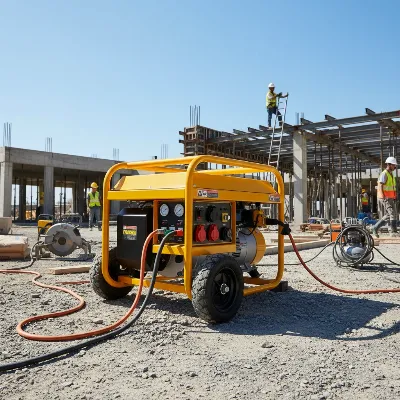 Heavy duty portable generator operating on a construction site, powering various tools under bright sunlight.
Key Factors When Choosing a Heavy Duty Portable Generator
Selecting the right heavy duty portable generator requires careful consideration of several critical factors to ensure it meets your specific job site needs.
Power Output (Wattage)
The most crucial factor is determining the power output you require. This involves calculating both the running watts (continuous power needed for tools) and starting watts (the brief surge of power required when motor-driven tools, like saws or compressors, first start). Always sum the running watts of all tools you plan to use simultaneously and identify the highest starting wattage among them. It’s a good practice to choose a generator with a peak power output that provides a 20-30% buffer above your calculated total running watts to prevent overloading and ensure smooth operation. For small crews, 8,000–12,000 running watts might suffice, while larger projects can demand units from 20 kW up to 100 kW or more.
Fuel Type
|
Our Picks for the Best Portable Generator in 2026
As an Amazon Associate I earn from qualifying purchases.
|
||
| Num | Product | Action |
|---|---|---|
| 1 | maXpeedingrods 2400 Watt Portable Inverter Generator Gas Powered, Bluetooth® App Remote Data Monitor,Only 33lbs, Compact and Lightweight for Outdoor Camping, Home Use |

|
| 2 | Champion Power Equipment 2500-Watt Dual Fuel Portable Inverter Generator with Quiet Technology and CO Shield |
|
| 3 | Westinghouse 155Wh 150 Peak Watt Portable Power Station & Solar Generator, Modified Sine Wave AC Outlet, Backup Lithium Battery for Camping, Home, Travel, Indoor/Outdoor Use (Solar Panel Not Included) |
|
| 4 | Honda 664240 EU2200i 2200 Watt Portable Inverter Generator with Co-Minder |
|
| 5 | GENMAX Portable Inverter Generator, 6000W open frame Gas Powered High Speed Engine with Electric Start, Ultra Lightweight for Backup Home Use & Job Site,EPA Compliant (GM6000XiE) |
|
| 6 | Anker SOLIX C1000 Portable Power Station, 1800W (Peak 2400W) Solar Generator, Full Charge in 58 Min, 1056wh LiFePO4 Battery for Home Backup, Power Outages, and Outdoor Camping (Optional Solar Panel) |
|
| 7 | 5000 Watts Portable Dual Fuel Inverter Generator– Small Gasoline LPG Powered for Home Backup, Camping, RV, Tailgating with CO Protection, Eco Mode, Recoil/Electric/Remote Start, Parallel Capable |
|
| 8 | BLUETTI Portable Power Station AC180, 1152Wh LiFePO4 Battery Backup w/ 2 1800W (2700W peak) AC Outlets, 0-80% in 45Min, Solar Generator for Camping, Off-grid, Power Outage |
|
| 9 | Generac 2,500-Watt Gas Powered Portable Inverter Generator - Lightweight and Compact Design - Produces Clean, Stable Power - Quiet Operation - Great for Home Backup, Camping, and RV Use |
|
| 10 | Anker SOLIX C1000 Gen 2 Portable Power Station, 2,000W (Peak 3,000W) Solar Generator, Full Charge in 49 Min, 1,024Wh LiFePO4 Battery for Home Backup, Power Outages, and Camping (Optional Solar Panel) |
|
Heavy duty portable generators come in several fuel configurations, each with distinct advantages:
- Gasoline: Widely available and offers good power density, but has a shorter shelf life and requires fuel stabilizers for storage.
- Propane (LPG): Burns cleaner than gasoline, has an indefinite shelf life, and can be easily stored in tanks. However, it often provides slightly lower peak power compared to gasoline.
- Natural Gas (NG): Excellent for very long runtimes if a natural gas pipeline connection is available, making it ideal for semi-permanent setups. It typically offers the lowest power output per unit of fuel compared to gasoline or propane.
- Diesel: Known for superior fuel efficiency, robust performance under heavy loads, and better operation in colder climates as it doesn’t freeze easily. Diesel generators are often the “gold standard” for continuous, high-demand job site operations.
- Dual-Fuel or Tri-Fuel: These versatile generators offer the flexibility to switch between two or three fuel types (e.g., gasoline/propane, or gasoline/propane/natural gas). This provides exceptional resilience against fuel shortages and allows you to utilize the most cost-effective or readily available fuel on a given site.
Runtime and Fuel Efficiency
For job sites, minimizing downtime for refueling is critical. Look for generators with larger fuel tanks and fuel-efficient engines that can provide extended runtimes, ideally capable of lasting a full work shift or longer under typical loads. Diesel generators generally offer the best fuel efficiency and longest runtimes, especially under continuous heavy loads.
Noise Level
Construction sites are inherently noisy, but noise regulations in residential or commercial areas can restrict generator use. Standard heavy-duty generators typically operate around 70 dB(A) at 23 feet. If your job site is in a noise-sensitive area, consider models with additional sound attenuation or quieter inverter technology to comply with local ordinances and reduce worker fatigue.
Additional Features
- Portability & Size: While “portable” is in the name, heavy-duty units can be substantial. Evaluate the generator’s weight, the presence of robust wheel kits, and dedicated lifting eyes. For units over 300 lbs, plan for a dolly, forklift, or trailer for safe repositioning. Consider if multiple smaller generators offer more flexibility than one large, cumbersome unit.
- Connection Compatibility: Ensure the generator provides the specific outlets and voltage options required for your tools. Common connections include standard 20-amp duplex receptacles, 30-amp twist-lock receptacles (popular with rental equipment), quick-connect Camlock connectors for high amperage, and electrical lugs for direct wiring by an electrician. Various voltage options like 120/240V single-phase or 120/208V/277/480V three-phase are available depending on industrial requirements.
- Durability and Build Quality: A rugged, heavy-gauge steel frame, durable engine components, and covered outlets are essential to withstand the bumps, dust, and debris of a job site.
- Safety Features: Modern generators often include critical safety features such as CO (carbon monoxide) sensors with automatic shutdown, low oil shutoff to protect the engine, and robust circuit breakers to prevent overloads.
- Clean Power (Total Harmonic Distortion – THD): If you’ll be powering sensitive electronics like laptops, battery chargers for cordless tools, or diagnostic equipment, look for generators with low Total Harmonic Distortion (THD), ideally less than 5%, to prevent damage.
- Ease of Use & Maintenance: Features like electric start, automatic idle control (to save fuel during light loads), and easy access to maintenance points (oil, air filter) can significantly improve the user experience and longevity. A simple OHV engine design also often makes field servicing easier.
Comparison of Popular Heavy Duty Portable Generators
To illustrate the diversity and features available, here’s a comparison of a few popular heavy-duty portable generators frequently chosen for job sites:
Detailed Comparison Table
| Feature | Generac GP9500 Tri-Fuel | Champion 16,875W | DuroMax XP10000E | Westinghouse 12500W Dual Fuel |
|---|---|---|---|---|
| Running Watts | 9,500W | 13,500W | 8,000W | 9,500W (Gas) |
| Peak Watts | 12,500W | 16,875W | 10,000W | 12,500W (Gas) |
| Fuel Type | Gas/Propane/Natural Gas | Gasoline | Gasoline | Gas/Propane |
| Runtime @ 50% Load | ~10 hours (Gas) | ~8 hours | ~8 hours | ~10 hours (Gas) |
| Noise Level | ~74 dB | ~78 dB | ~72 dB | ~74 dB |
| Key Advantage | Ultimate fuel flexibility | High capacity, robust for heavy loads | Rugged, high-output, economical | Excellent value, fuel flexibility |
| Best For | Site managers needing uptime flexibility | Heavy construction, simultaneous tool use | Medium to large jobs, cost-effective | Mid-tier crews, reliable power with fuel options |
This table provides a snapshot, but deeper analysis of each model’s specific features, safety protocols, and build quality is essential.
Heavy Duty Portable Generator Buying Guide
Making an informed decision about a heavy duty portable generator involves a structured approach to ensure you get the best fit for your operational needs.
Determine Your Power Needs
Start by making a comprehensive list of all the tools and equipment you intend to power simultaneously. For each item, note its running wattage and starting (surge) wattage. Prioritize critical tools and add up their running watts. Then, identify the tool with the highest starting wattage and add that to your total running watts (ignoring the starting watts of other tools, as they likely won’t all start at the exact same instant). Add a 20-30% buffer to this total to account for unexpected surges and to prevent overloading, aiming for a generator that typically runs at 70-80% of its maximum capacity for optimal performance and longevity.
Budget
Portable generators for job sites vary widely in price, from under $1,000 for smaller dual-fuel units to several thousands for industrial-grade models. Establish a realistic budget, but remember that investing in a higher-quality, more durable, and feature-rich generator can lead to significant cost savings in the long run through reduced maintenance, better fuel efficiency, and increased productivity. Consider the long-term return on investment (ROI) rather than just the initial purchase price. Also, weigh the pros and cons of renting versus owning, especially for short-term or infrequent projects.
Brand Reputation and Reliability
Research reputable brands known for their heavy-duty portable generators, such as Generac, Champion, DuroMax, Westinghouse, and Pulsar. Read independent reviews from other contractors and professionals. A brand’s reputation often reflects its commitment to quality, durability, and customer support. Look for manufacturers with a strong network of certified service centers and readily available spare parts, as this is crucial for minimizing downtime on a busy job site.
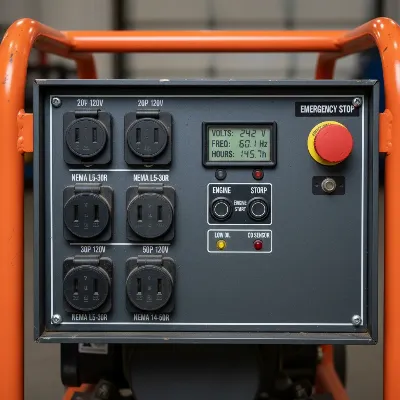 Close-up of a heavy duty portable generator's control panel with various power outlets and safety features visible.
Top-Rated Heavy Duty Portable Generators for Job Sites
Based on power, durability, fuel flexibility, and contractor feedback, here are a few top models that stand out for job site use:
- Generac GP9500 Tri-Fuel: This model is a contractor favorite for its exceptional fuel resilience. Operating on gasoline, propane, or natural gas, it provides ultimate flexibility, ensuring power availability even when one fuel source is scarce. With 9,500 running watts and 12,500 peak watts, it can handle a wide range of tools and is designed with job site durability in mind, including covered outlets and a heavy frame. It’s an excellent choice for sites that require absolute uptime.
- Champion 16,875W (13,500 Running Watts): Known for its massive wattage, this Champion generator is built for heavy construction needs, capable of running welders, compressors, and extensive lighting simultaneously. It features Champion’s CO Shield safety technology, ensuring worksite safety, and benefits from a well-established support network. While primarily gasoline-powered in many configurations, its sheer output and robust build make it a top contender for demanding applications.
- DuroMax XP10000E (8,000 Running Watts): This unit is a rugged, high-output workhorse that offers excellent value. It provides ample headroom for multiple high-draw tools without frequent load shedding. Its simple OHV engine design ensures good serviceability in the field, and its proven frame and 120/240V output allow for running substantial equipment like arc welders or large air compressors. It’s a reliable, cost-effective choice for medium to large jobs where gasoline is readily available.
> “Choosing a generator is not just about raw power; it’s about matching the right machine to the specific demands and conditions of your job site. Durability, fuel flexibility, and reliable support are just as critical as wattage.” – Admin, ReviewMyHand.com, Portable Generator Specialist
Maintaining and Using Heavy Duty Portable Generators Correctly
Proper maintenance and safe operating procedures are paramount for extending the life of your heavy duty portable generator and ensuring safety on the job site.
Regular Maintenance to Extend Lifespan
- Check Oil Levels: Before each use, verify the engine oil level and top it off or change it according to the manufacturer’s schedule.
- Inspect Air Filter: Clean or replace the air filter regularly, especially in dusty job site environments, to ensure proper engine breathing.
- Spark Plug Check: Periodically inspect and clean or replace the spark plug for efficient combustion.
- Fuel System Care: For gasoline generators, use fuel stabilizer when storing the unit for extended periods. Drain the carburetor if storing for more than a month to prevent fuel degradation. For diesel units, ensure fuel filters are clean.
- Battery Maintenance: If equipped with an electric start, check the battery terminals for corrosion and ensure it holds a charge.
- General Cleaning: Keep the generator free from dirt, dust, and debris. Clean cooling fins to prevent overheating.
Safety Measures When Using Portable Generators
- Operate Outdoors ONLY: Never operate a generator indoors, in garages, or in partially enclosed spaces. Generators produce carbon monoxide (CO), an odorless, colorless, and deadly gas. Ensure adequate ventilation.
- Proper Grounding: Always ensure the generator is properly grounded as per manufacturer instructions to prevent electrical shock.
- Fuel Handling: Refuel only when the engine is off and cool. Use the correct fuel type. Store fuel in approved containers away from living areas and ignition sources.
- Keep Dry: Protect the generator from rain and moisture. Operating a wet generator can lead to electrocution.
- Secure Connections: Use heavy-duty, outdoor-rated extension cords that are in good condition and appropriately sized for the load. Ensure all connections are secure.
- Overload Protection: Do not overload the generator. Understand its wattage limits and rely on built-in circuit breakers.
- Distance: Position the generator far enough from windows, doors, and vents to prevent exhaust fumes from entering buildings.
Troubleshooting Common Issues
- Generator Won’t Start: Check fuel level and quality, engine oil level, spark plug condition, and ensure the on/off switch is in the “on” position.
- Low Power Output: This could indicate an overload (reduce connected tools), dirty air filter, or stale fuel.
- Engine Shuts Off: Often triggered by low oil pressure (check oil level) or a CO sensor activation (move to a better-ventilated area).
- No Power at Outlets: Check circuit breakers on the generator and any connected extension cords. Ensure the generator is running at the correct RPM.
Conclusion
Choosing the right heavy duty portable generator is a crucial decision for any contractor or project manager. By carefully evaluating power requirements, fuel options, portability, safety features, and durability, you can select a unit that not only meets your current needs but also provides reliable power for years to come. Investing in a quality generator and adhering to proper maintenance and safety guidelines will ensure your job site remains productive, efficient, and safe. Are you ready to empower your next project with unwavering portable power?
Frequently Asked Questions
How many watts do I typically need for a small construction crew?
For a small construction crew running basic lighting, a compressor, and a few power tools simultaneously, you should plan for approximately 8,000–12,000 running watts. Always factor in the additional surge wattage required for motor-driven tools when they start up.
Is a dual-fuel portable generator worth the investment for contractors?
Yes, a dual-fuel generator is highly recommended for contractors. The ability to switch between gasoline and propane provides excellent flexibility and resilience, especially in situations where one fuel type might be unavailable or for longer storage times of propane. This reduces potential downtime on job sites.
Are inverter generators suitable for heavy-duty job site applications?
Inverter generators are excellent for powering sensitive electronics like battery chargers, laptops, and delicate diagnostic equipment due to their clean sine wave power and quieter operation. However, for high-draw tools such as large welders, air compressors, or concrete mixers, conventional open-frame heavy-duty generators with robust peak wattage and voltage regulation are generally more appropriate and cost-effective.
How do I properly size a portable generator to run a welder?
When sizing a generator for a welder, it’s crucial to check the welder’s surge (starting) watts, which can be two to three times its running watts. Welding arcs demand significant peak capacity. Ensure the chosen generator not only meets this peak demand but also has robust voltage regulation to handle the intermittent, heavy loads without damaging the welder or other connected equipment.
