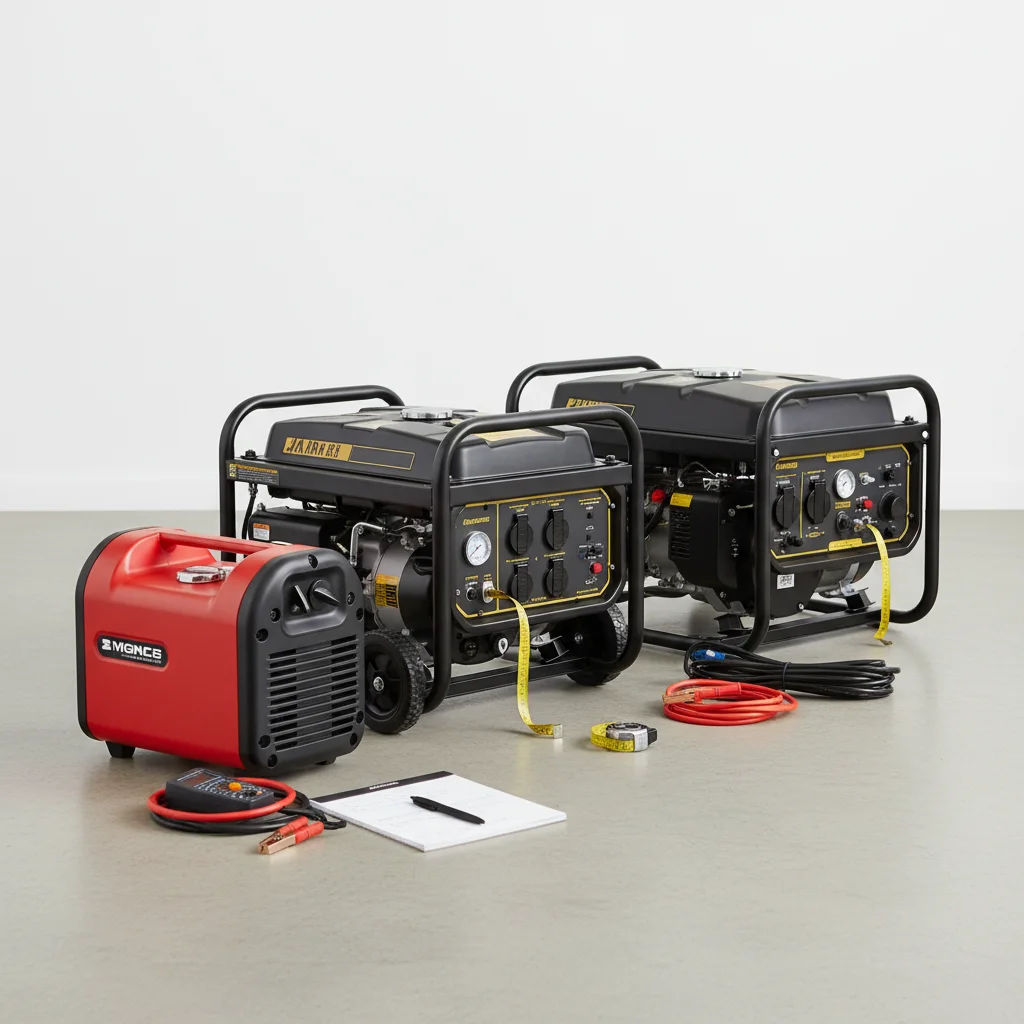
Determining the correct portable generator sizing is crucial for ensuring you have adequate power without overspending. For most homeowners, a generator between 3,000 and 7,500 running watts will suffice for essential home backup, while camping or RV use might require less, typically 2,000 to 4,000 watts. This guide will help you calculate your specific power needs to select the perfect generator.
Understanding Your Power Requirements
Before purchasing a portable generator, it’s essential to list all the appliances and devices you plan to power. Each appliance has two power ratings: starting watts (surge watts) and running watts (continuous watts). Starting watts are the brief burst of power an appliance needs to start, especially those with motors like refrigerators or air conditioners. Running watts are the power required to keep the appliance operating. Always prioritize the starting watts for your highest-demand appliance when calculating total needs. For compare top portable generator on this site.
- Identify essential appliances (refrigerator, lights, phone chargers).
- Note the starting and running watts for each appliance.
- Consider peak usage scenarios (e.g., all essential items running simultaneously).
- Factor in a 10-20% buffer for future needs or unexpected demands.
Calculating Total Wattage for Home Backup
For home backup, focus on critical appliances. A typical refrigerator might need 600 running watts and 1800 starting watts. A few lights could be 100 watts each. A furnace fan might require 800 running watts and 2000 starting watts. Sum the running watts of all items you expect to run simultaneously, then add the highest starting wattage from any single appliance to that sum. For example, if your running total is 3000 watts and your refrigerator has the highest starting wattage at 1800, your minimum generator size should be around 4800 watts to handle the initial surge.
Many homeowners find that a 5,000-watt generator can comfortably power a refrigerator, a few lights, a TV, and a small window AC unit. For more extensive needs, including a well pump or central air conditioning, you might need a 7,500-watt or even 10,000-watt generator. Always check the specific wattage requirements on your appliance labels or manuals.
Sizing for RVs and Camping
|
Our Picks for the Best Portable Generator in 2026
As an Amazon Associate I earn from qualifying purchases.
|
||
| Num | Product | Action |
|---|---|---|
| 1 | BLUETTI Portable Power Station AC180, 1152Wh LiFePO4 Battery Backup w/ 2 1800W (2700W peak) AC Outlets, 0-80% in 45Min, Solar Generator for Camping, Off-grid, Power Outage |

|
| 2 | Champion Power Equipment 2500-Watt Dual Fuel Portable Inverter Generator with Quiet Technology and CO Shield |
|
| 3 | Anker SOLIX C1000 Portable Power Station, 1800W (Peak 2400W) Solar Generator, Full Charge in 58 Min, 1056wh LiFePO4 Battery for Home Backup, Power Outages, and Outdoor Camping (Optional Solar Panel) |
|
| 4 | maXpeedingrods 2400 Watt Portable Inverter Generator Gas Powered, Bluetooth® App Remote Data Monitor,Only 33lbs, Compact and Lightweight for Outdoor Camping, Home Use |
|
| 5 | Honda 664240 EU2200i 2200 Watt Portable Inverter Generator with Co-Minder |
|
| 6 | 5000 Watts Portable Dual Fuel Inverter Generator– Small Gasoline LPG Powered for Home Backup, Camping, RV, Tailgating with CO Protection, Eco Mode, Recoil/Electric/Remote Start, Parallel Capable |
|
| 7 | Generac 2,500-Watt Gas Powered Portable Inverter Generator - Lightweight and Compact Design - Produces Clean, Stable Power - Quiet Operation - Great for Home Backup, Camping, and RV Use |
|
| 8 | Anker SOLIX C1000 Gen 2 Portable Power Station, 2,000W (Peak 3,000W) Solar Generator, Full Charge in 49 Min, 1,024Wh LiFePO4 Battery for Home Backup, Power Outages, and Camping (Optional Solar Panel) |
|
| 9 | Westinghouse 155Wh 150 Peak Watt Portable Power Station & Solar Generator, Modified Sine Wave AC Outlet, Backup Lithium Battery for Camping, Home, Travel, Indoor/Outdoor Use (Solar Panel Not Included) |
|
| 10 | GENMAX Portable Inverter Generator, 6000W open frame Gas Powered High Speed Engine with Electric Start, Ultra Lightweight for Backup Home Use & Job Site,EPA Compliant (GM6000XiE) |
|
RV and camping needs are generally lower than home backup. A 2,000-watt inverter generator is often sufficient for basic camping, powering lights, phone chargers, and perhaps a small coffee maker. For RVs with air conditioners, you’ll need more power. A 13,500 BTU RV air conditioner typically requires around 1,500-2,000 running watts and 3,000-3,500 starting watts. In this case, a 3,000- to 4,000-watt generator would be a good fit.
Consider the type of camping you do. If you’re boondocking and relying heavily on your generator, a larger unit might be necessary. If you’re just using it for occasional power, a smaller, quieter inverter generator is ideal.
Factors Beyond Wattage: Fuel Type and Features
Beyond just wattage, consider the fuel type. Gasoline generators are common, but dual-fuel models (gasoline and propane) offer flexibility. Propane burns cleaner and stores longer, while gasoline is more readily available in many areas. Also, look for features like electric start, multiple outlets, and a fuel gauge. Inverter generators, while often more expensive, provide clean power safe for sensitive electronics and are generally quieter and more fuel-efficient.
Noise level is another critical factor, especially for camping or residential use. Inverter generators are typically much quieter than conventional portable generators. Check the decibel rating; anything below 60 dB is considered relatively quiet.
Common Sizing Mistakes to Avoid
One common mistake is underestimating starting wattage, leading to an overloaded generator that trips breakers or struggles to start appliances. Another is overestimating, buying a generator far larger than needed, which results in higher fuel consumption and unnecessary expense. Always create a detailed power budget. Also, remember that generators lose some efficiency at higher altitudes, so factor that in if you live or plan to use your generator in mountainous regions.
