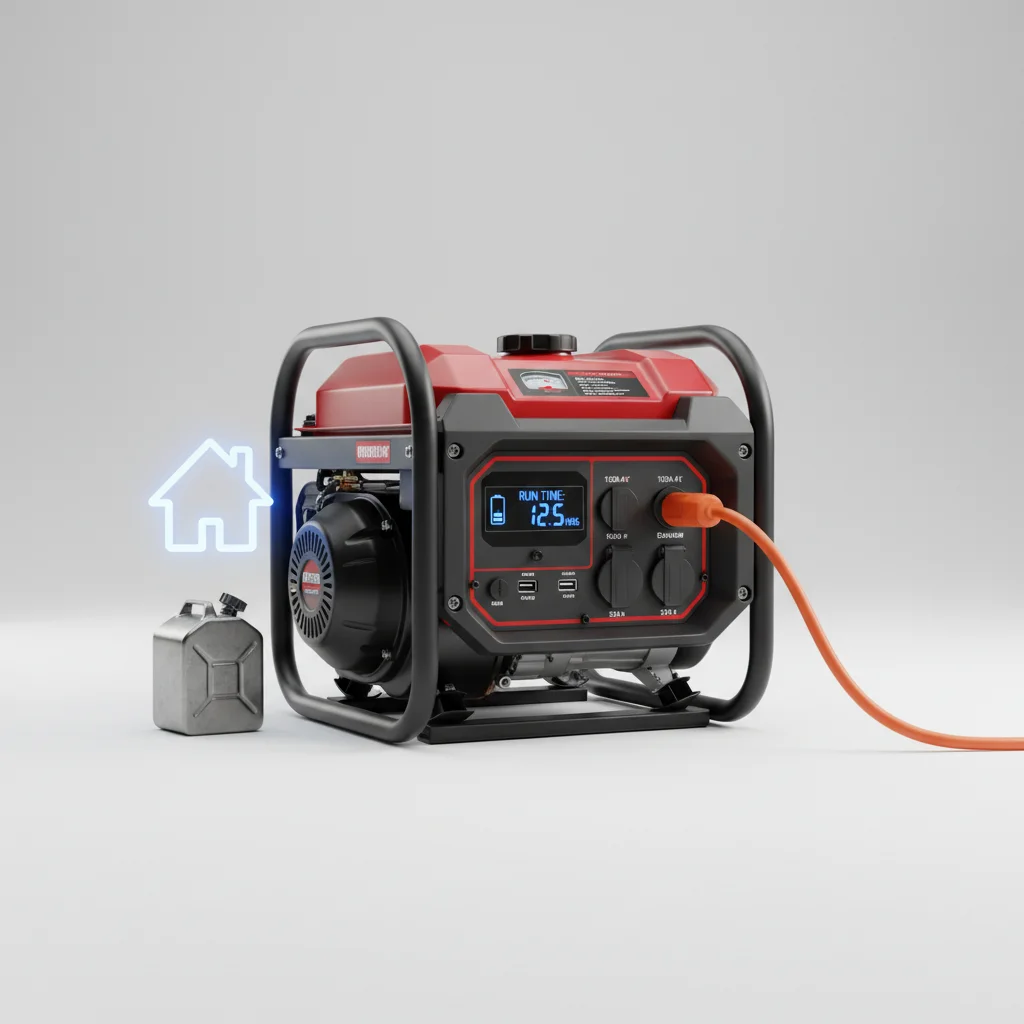
Understanding the typical run time of a portable generator is crucial for effective power management during outages or off-grid activities. On average, a portable generator can run for 8 to 12 hours on a single tank of fuel, though this can vary significantly based on the generator’s wattage, fuel tank capacity, and the load it’s powering. For instance, a 5,000-watt generator with a 5-gallon fuel tank might run for 10 hours at a 50% load, while a smaller 2,000-watt unit with a 1-gallon tank could last 4-6 hours under similar conditions.
Factors Influencing Portable Generator Run Time
Several key factors dictate how long your portable generator will operate before needing a refuel. The most significant is the fuel tank capacity; larger tanks naturally allow for longer run times. However, the load connected to the generator is equally important. Running a generator at its maximum capacity will deplete fuel much faster than running it at a quarter or half load. Engine efficiency also plays a role, with newer inverter generators often offering better fuel economy compared to traditional open-frame models. Environmental conditions like extreme cold can also slightly reduce fuel efficiency.
Calculating Your Generator’s Expected Run Time
To estimate your portable generator’s run time, you’ll need to know its fuel consumption rate at various loads, usually provided in the owner’s manual. For example, if your generator consumes 0.5 gallons per hour at a 50% load and has a 6-gallon tank, you can expect it to run for approximately 12 hours (6 gallons / 0.5 gallons/hour). It’s always wise to perform a test run with your typical load to get a more accurate real-world estimate. Keep a log of fuel consumption during these tests to better plan for extended outages.
- Check your generator’s owner’s manual for specific fuel consumption rates.
- Determine the total wattage of the appliances you plan to power.
- Calculate the percentage of your generator’s maximum output that your load represents.
- Use the fuel consumption rate at that load percentage to estimate run time.
- Always factor in a safety margin and have extra fuel on hand.
Maximizing Portable Generator Run Time
|
Our Picks for the Best Portable Generator in 2026
As an Amazon Associate I earn from qualifying purchases.
|
||
| Num | Product | Action |
|---|---|---|
| 1 | BLUETTI Portable Power Station AC180, 1152Wh LiFePO4 Battery Backup w/ 2 1800W (2700W peak) AC Outlets, 0-80% in 45Min, Solar Generator for Camping, Off-grid, Power Outage |

|
| 2 | Generac 2,500-Watt Gas Powered Portable Inverter Generator - Lightweight and Compact Design - Produces Clean, Stable Power - Quiet Operation - Great for Home Backup, Camping, and RV Use |
|
| 3 | maXpeedingrods 2400 Watt Portable Inverter Generator Gas Powered, Bluetooth® App Remote Data Monitor,Only 33lbs, Compact and Lightweight for Outdoor Camping, Home Use |
|
| 4 | Anker SOLIX C1000 Portable Power Station, 1800W (Peak 2400W) Solar Generator, Full Charge in 58 Min, 1056wh LiFePO4 Battery for Home Backup, Power Outages, and Outdoor Camping (Optional Solar Panel) |
|
| 5 | 5000 Watts Portable Dual Fuel Inverter Generator– Small Gasoline LPG Powered for Home Backup, Camping, RV, Tailgating with CO Protection, Eco Mode, Recoil/Electric/Remote Start, Parallel Capable |
|
| 6 | Westinghouse 155Wh 150 Peak Watt Portable Power Station & Solar Generator, Modified Sine Wave AC Outlet, Backup Lithium Battery for Camping, Home, Travel, Indoor/Outdoor Use (Solar Panel Not Included) |
|
| 7 | Honda 664240 EU2200i 2200 Watt Portable Inverter Generator with Co-Minder |
|
| 8 | Champion Power Equipment 2500-Watt Dual Fuel Portable Inverter Generator with Quiet Technology and CO Shield |
|
| 9 | GENMAX Portable Inverter Generator, 6000W open frame Gas Powered High Speed Engine with Electric Start, Ultra Lightweight for Backup Home Use & Job Site,EPA Compliant (GM6000XiE) |
|
| 10 | Anker SOLIX C1000 Gen 2 Portable Power Station, 2,000W (Peak 3,000W) Solar Generator, Full Charge in 49 Min, 1,024Wh LiFePO4 Battery for Home Backup, Power Outages, and Camping (Optional Solar Panel) |
|
To extend the operational period of your portable generator, consider a few strategies. First, prioritize essential appliances to reduce the overall load on the generator. Running fewer items at once will significantly lower fuel consumption. Second, ensure your generator is well-maintained; a clean air filter and fresh oil can improve efficiency. Third, consider investing in an auxiliary fuel tank if your generator supports one, or simply have approved fuel containers readily available. Remember to always refuel safely with the generator turned off and cooled down.
For those seeking extended run times without constant refueling, certain models are designed with larger fuel tanks or superior fuel efficiency. These often come at a higher price point but can be invaluable during prolonged power outages.These generators are specifically engineered to provide hours of continuous power, making them ideal for emergency home backup or remote job sites where frequent refueling is impractical. Always compare the fuel efficiency ratings when making a purchase decision.
Safety Considerations for Extended Operation
While extending run time is desirable, safety must remain paramount. Never operate a portable generator indoors or in enclosed spaces due to the risk of carbon monoxide poisoning. Ensure adequate ventilation and place the generator at least 20 feet away from your home’s windows and doors. Regularly check the oil level during extended operation, as low oil can cause engine damage. Allow the generator to cool down before refueling to prevent fire hazards.Adhering to these safety guidelines will help ensure both your generator’s longevity and your family’s well-being.
