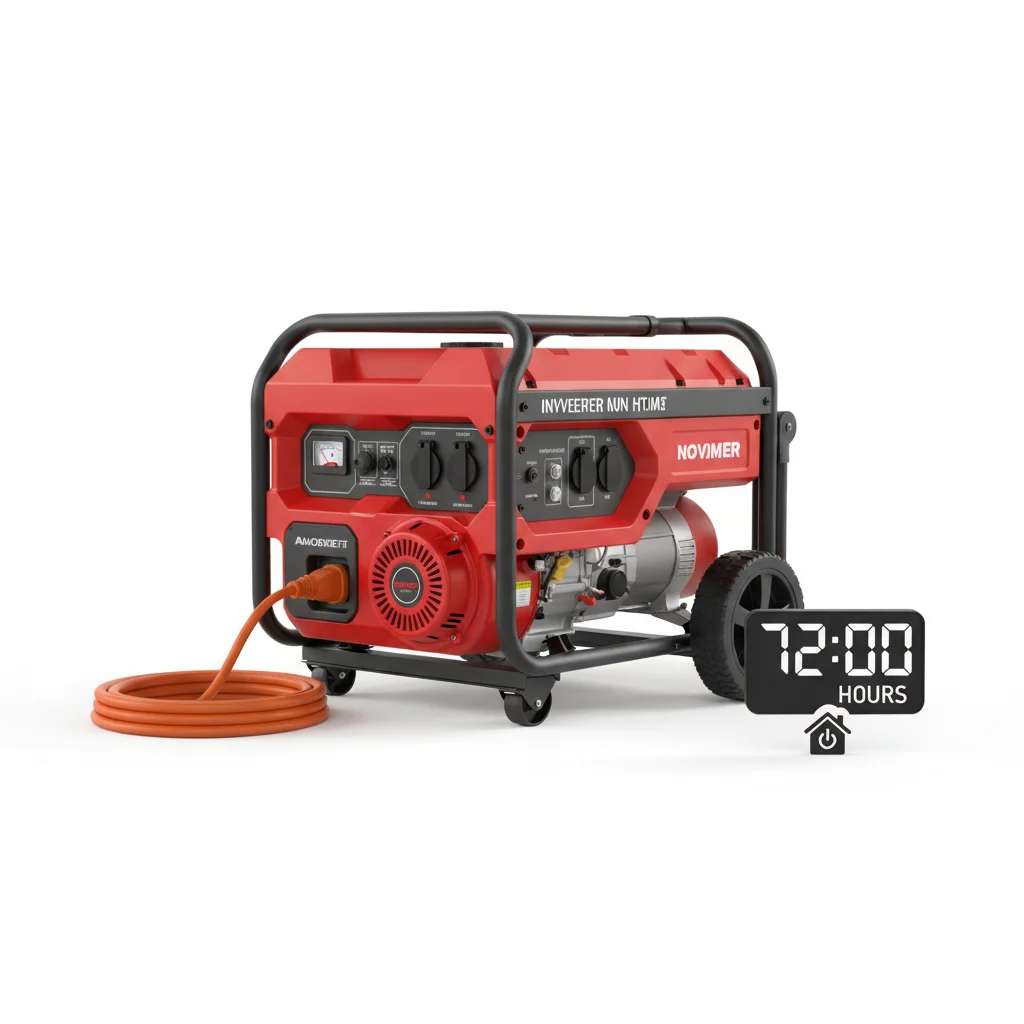
Understanding your portable generator’s run time is crucial for effective power management during outages or off-grid use. On average, a typical portable generator with a 5-gallon fuel tank can run for 8 to 12 hours at a 50% load. This duration can vary significantly based on the generator’s fuel efficiency, tank size, and the actual load it’s supporting.
Factors Influencing Portable Generator Run Time
Several key factors dictate how long your portable generator will operate on a single tank of fuel. The most significant is the load percentage. A generator running at 25% load will consume less fuel and thus run longer than one operating at 75% or 100% load. Engine size and efficiency also play a critical role; newer, more efficient engines are designed to maximize fuel economy. Furthermore, the ambient temperature can affect fuel consumption, with colder temperatures potentially leading to slightly higher usage.
Fuel tank capacity is another straightforward determinant. A larger fuel tank, naturally, allows for longer operation between refills. However, it’s important to balance tank size with portability and storage considerations. For extended outages, having extra fuel safely stored is often more practical than relying solely on a massive built-in tank.
Calculating Your Generator’s Expected Run Time
To estimate your portable generator’s run time, you’ll need to know its fuel consumption rate at various loads and its fuel tank capacity. Most manufacturers provide fuel consumption data in their specifications, often expressed in gallons per hour (GPH) at specific load percentages (e.g., 0.5 GPH at 50% load). Multiply your tank capacity by the inverse of the GPH rate to get an approximate run time. For example, a 5-gallon tank with a consumption rate of 0.5 GPH at 50% load would yield approximately 10 hours of run time (5 gallons / 0.5 GPH = 10 hours).
It’s always wise to perform a real-world test if possible, especially when first using a new generator or after significant maintenance. This helps you understand its actual performance under your specific load conditions.
Maximizing Portable Generator Run Time
|
Our Picks for the Best Portable Generator in 2026
As an Amazon Associate I earn from qualifying purchases.
|
||
| Num | Product | Action |
|---|---|---|
| 1 | Honda 664240 EU2200i 2200 Watt Portable Inverter Generator with Co-Minder |

|
| 2 | Generac 2,500-Watt Gas Powered Portable Inverter Generator - Lightweight and Compact Design - Produces Clean, Stable Power - Quiet Operation - Great for Home Backup, Camping, and RV Use |
|
| 3 | BLUETTI Portable Power Station AC180, 1152Wh LiFePO4 Battery Backup w/ 2 1800W (2700W peak) AC Outlets, 0-80% in 45Min, Solar Generator for Camping, Off-grid, Power Outage |
|
| 4 | Westinghouse 155Wh 150 Peak Watt Portable Power Station & Solar Generator, Modified Sine Wave AC Outlet, Backup Lithium Battery for Camping, Home, Travel, Indoor/Outdoor Use (Solar Panel Not Included) |
|
| 5 | 5000 Watts Portable Dual Fuel Inverter Generator– Small Gasoline LPG Powered for Home Backup, Camping, RV, Tailgating with CO Protection, Eco Mode, Recoil/Electric/Remote Start, Parallel Capable |
|
| 6 | Anker SOLIX C1000 Portable Power Station, 1800W (Peak 2400W) Solar Generator, Full Charge in 58 Min, 1056wh LiFePO4 Battery for Home Backup, Power Outages, and Outdoor Camping (Optional Solar Panel) |
|
| 7 | Champion Power Equipment 2500-Watt Dual Fuel Portable Inverter Generator with Quiet Technology and CO Shield |
|
| 8 | maXpeedingrods 2400 Watt Portable Inverter Generator Gas Powered, Bluetooth® App Remote Data Monitor,Only 33lbs, Compact and Lightweight for Outdoor Camping, Home Use |
|
| 9 | Anker SOLIX C1000 Gen 2 Portable Power Station, 2,000W (Peak 3,000W) Solar Generator, Full Charge in 49 Min, 1,024Wh LiFePO4 Battery for Home Backup, Power Outages, and Camping (Optional Solar Panel) |
|
| 10 | GENMAX Portable Inverter Generator, 6000W open frame Gas Powered High Speed Engine with Electric Start, Ultra Lightweight for Backup Home Use & Job Site,EPA Compliant (GM6000XiE) |
|
Extending your generator’s run time involves a combination of smart usage and proper maintenance. First, prioritize essential appliances to reduce the overall load. Avoid running high-wattage items simultaneously if they are not critical. Second, ensure your generator is well-maintained, with clean air filters and fresh oil, as a well-tuned engine operates more efficiently. Third, consider using an inverter generator, which can adjust engine speed to match the load, significantly improving fuel efficiency compared to conventional generators that run at a constant RPM.
- Reduce unnecessary electrical loads.
- Perform regular maintenance (oil changes, air filter cleaning).
- Use an inverter generator for better fuel efficiency.
- Keep the generator in a well-ventilated area to prevent overheating.
- Monitor fuel levels frequently to avoid unexpected shutdowns.
Safe Fuel Storage and Refueling Practices
Safe fuel handling is paramount when dealing with portable generators. Always store gasoline in approved, clearly labeled containers in a cool, dry, well-ventilated area, away from living spaces and ignition sources. Never refuel a hot or running generator; allow it to cool down completely before adding fuel. Spilled fuel can ignite, leading to serious hazards. Use a funnel to prevent spills and wipe up any drips immediately. For longer storage, consider using a fuel stabilizer to prevent degradation and ensure easy starting when needed.
For reliable fuel storage solutions, check out. These containers are designed for safety and durability, ensuring your fuel remains viable for when you need it most. Always follow local regulations regarding fuel storage quantities and practices.
When to Consider a Larger Fuel Tank or Alternative Power
If your current portable generator’s run time consistently falls short of your needs, it might be time to evaluate alternatives. For very long outages or continuous off-grid living, a generator with a larger integrated fuel tank or the ability to connect to an external fuel source (like a propane tank) could be beneficial. Another option is to integrate a portable power station or a solar generator into your setup, which can provide quiet, emission-free power for smaller loads and extend the overall duration of your power supply. These can be particularly useful for overnight power needs when you want to conserve generator fuel or reduce noise.
Explore high-capacity portable power stations that can complement your generator for extended run times and quiet operation. Find the best options at.
