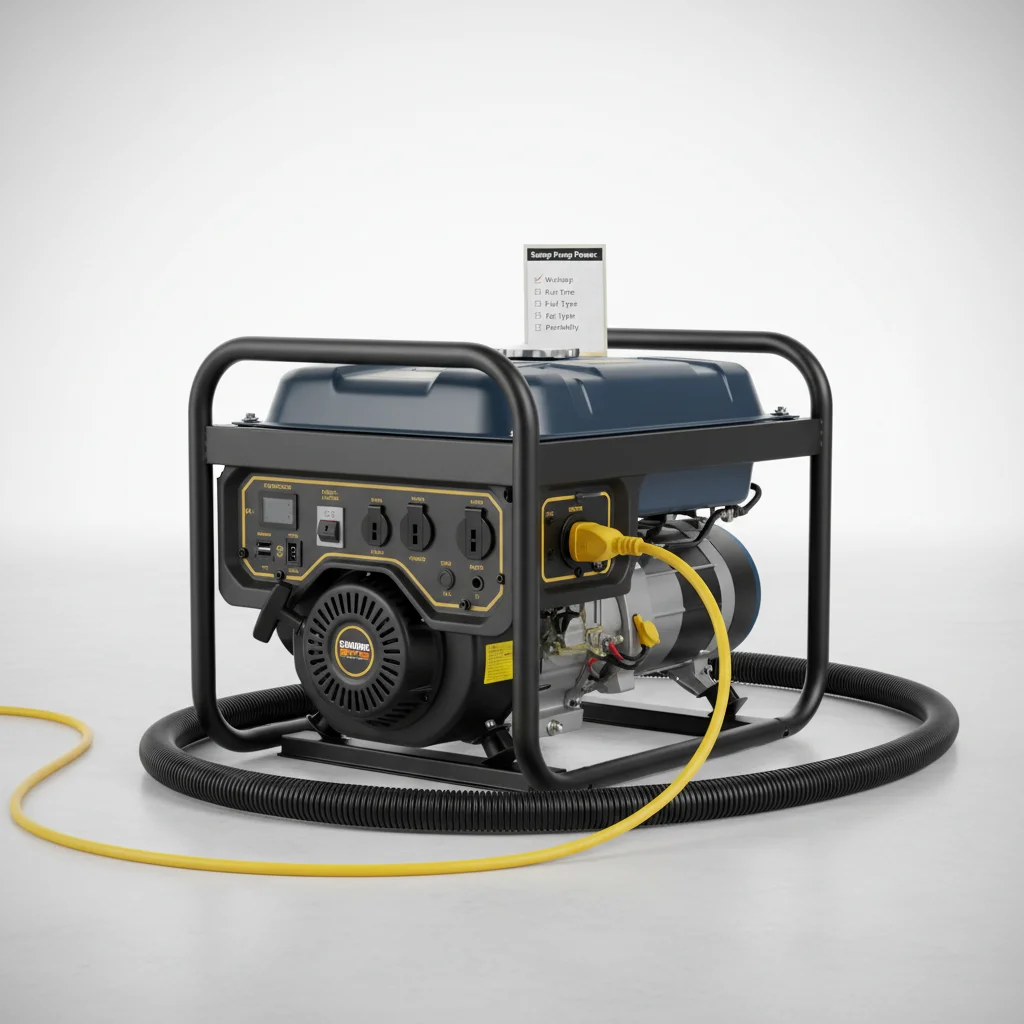
Choosing the right portable generator for your sump pump is crucial for preventing basement flooding during power outages. You’ll need a generator that can reliably power your sump pump, and often other essential appliances, for extended periods. The five key factors to consider are wattage requirements, fuel type, run time, noise level, and portability.
Understanding Sump Pump Wattage Requirements
The first step is to determine the wattage your sump pump requires. Most standard sump pumps need between 800 to 1500 running watts, with a starting (surge) wattage that can be two to three times higher. Check your sump pump’s label or manual for precise specifications. It’s always wise to choose a generator with a slightly higher capacity than your calculated needs to account for other small appliances you might want to power simultaneously, such as lights or a refrigerator. Overlooking surge wattage is a common mistake that can lead to an undersized generator failing to start your pump. For see our portable generator recommendations on this site.
Choosing the Right Fuel Type for Reliability
Portable generators typically run on gasoline, propane, or are dual-fuel (gasoline and propane). Gasoline is readily available but has a shorter shelf life and can be difficult to store safely long-term. Propane offers a longer shelf life, burns cleaner, and is easier to store, making it an excellent choice for emergency backup. Dual-fuel generators provide the most flexibility, allowing you to switch between fuel sources based on availability and preference. Consider the availability of fuel in your area and your storage capabilities when making this decision.
Assessing Run Time and Fuel Efficiency
|
Our Picks for the Best Portable Generator in 2026
As an Amazon Associate I earn from qualifying purchases.
|
||
| Num | Product | Action |
|---|---|---|
| 1 | Honda 664240 EU2200i 2200 Watt Portable Inverter Generator with Co-Minder |

|
| 2 | Generac 2,500-Watt Gas Powered Portable Inverter Generator - Lightweight and Compact Design - Produces Clean, Stable Power - Quiet Operation - Great for Home Backup, Camping, and RV Use |
|
| 3 | Anker SOLIX C1000 Portable Power Station, 1800W (Peak 2400W) Solar Generator, Full Charge in 58 Min, 1056wh LiFePO4 Battery for Home Backup, Power Outages, and Outdoor Camping (Optional Solar Panel) |
|
| 4 | Anker SOLIX C1000 Gen 2 Portable Power Station, 2,000W (Peak 3,000W) Solar Generator, Full Charge in 49 Min, 1,024Wh LiFePO4 Battery for Home Backup, Power Outages, and Camping (Optional Solar Panel) |
|
| 5 | GENMAX Portable Inverter Generator, 6000W open frame Gas Powered High Speed Engine with Electric Start, Ultra Lightweight for Backup Home Use & Job Site,EPA Compliant (GM6000XiE) |
|
| 6 | Champion Power Equipment 2500-Watt Dual Fuel Portable Inverter Generator with Quiet Technology and CO Shield |
|
| 7 | maXpeedingrods 2400 Watt Portable Inverter Generator Gas Powered, Bluetooth® App Remote Data Monitor,Only 33lbs, Compact and Lightweight for Outdoor Camping, Home Use |
|
| 8 | BLUETTI Portable Power Station AC180, 1152Wh LiFePO4 Battery Backup w/ 2 1800W (2700W peak) AC Outlets, 0-80% in 45Min, Solar Generator for Camping, Off-grid, Power Outage |
|
| 9 | 5000 Watts Portable Dual Fuel Inverter Generator– Small Gasoline LPG Powered for Home Backup, Camping, RV, Tailgating with CO Protection, Eco Mode, Recoil/Electric/Remote Start, Parallel Capable |
|
| 10 | Westinghouse 155Wh 150 Peak Watt Portable Power Station & Solar Generator, Modified Sine Wave AC Outlet, Backup Lithium Battery for Camping, Home, Travel, Indoor/Outdoor Use (Solar Panel Not Included) |
|
For a sump pump, especially during prolonged outages, run time is a critical factor. You’ll want a generator that can operate for at least 8-12 hours on a single tank of fuel at a 50% load. This minimizes the need for frequent refueling, which can be inconvenient and unsafe during a storm. Inverter generators are often more fuel-efficient than conventional generators, offering longer run times and quieter operation. Always check the manufacturer’s specifications for run time at various load levels.
- Prioritize generators with at least 8 hours of run time at 50% load.
- Consider inverter models for better fuel efficiency and quieter operation.
- Factor in the cost and availability of fuel for extended use.
- Ensure easy access for refueling, especially in adverse weather.
- Look for models with fuel gauges for convenient monitoring.
Considering Noise Levels for Residential Use
Generators can be noisy, which can be a significant concern if you live in a residential area or plan to use it close to your home. Conventional generators can produce noise levels upwards of 70 dB, comparable to a vacuum cleaner. Inverter generators, on the other hand, are significantly quieter, often operating in the 50-60 dB range, similar to a normal conversation. If noise is a primary concern, an inverter generator is the superior choice.
Evaluating Portability and Storage
While the generator will primarily be used for your sump pump, its portability is still important for setup, storage, and potential other uses. Look for models with wheels and a handle for easy maneuverability. Consider the generator’s weight and dimensions to ensure you can store it safely and accessibly when not in use. A compact design can be a significant advantage, especially if storage space is limited. Remember, you’ll need to move it outdoors for safe operation.
