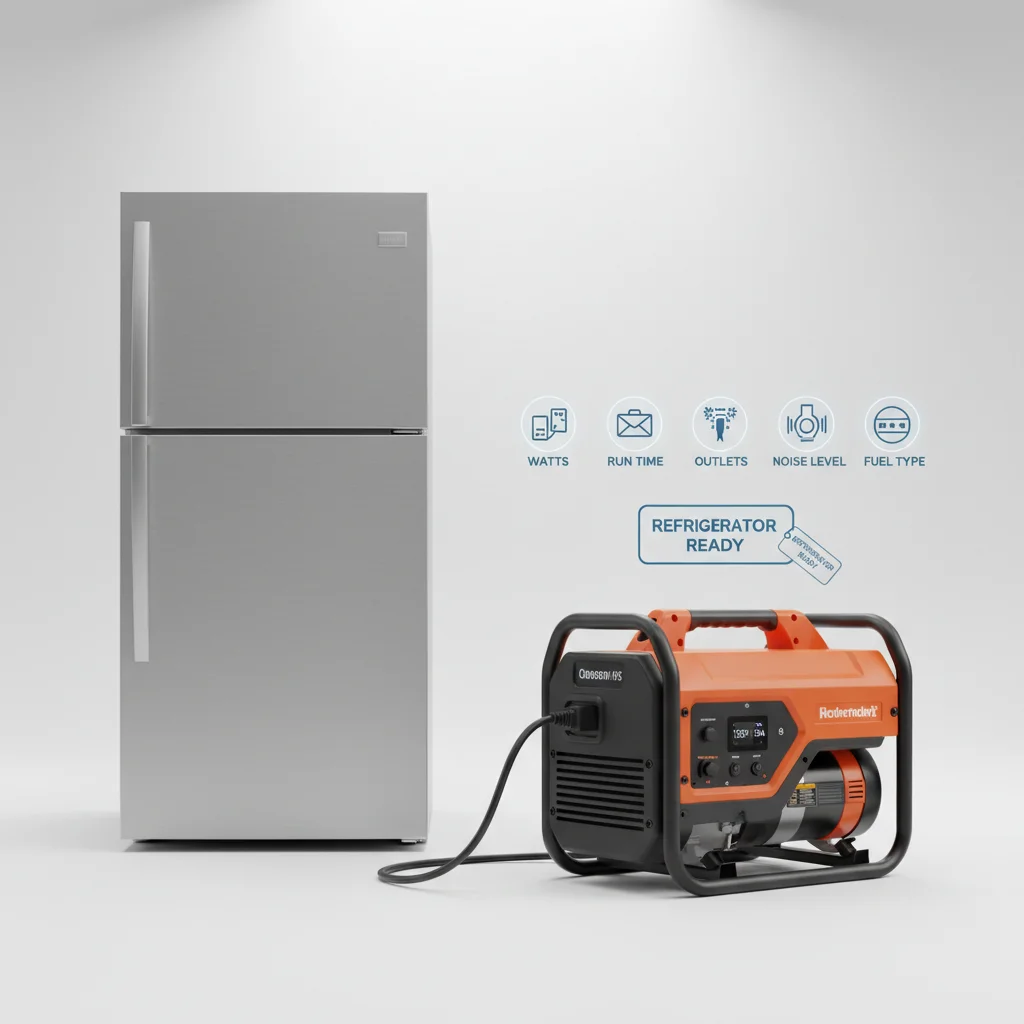
Choosing the right portable generator to power your refrigerator during an outage is crucial for preserving food and maintaining household comfort. You’ll need a generator that can handle the starting wattage (surge) and running wattage of your refrigerator, typically requiring at least 2000 surge watts and 800 running watts for a standard model. This ensures your food stays cold and your generator operates efficiently without being overloaded.
Understanding Refrigerator Power Needs
Refrigerators, especially older models, have a higher starting wattage (also known as surge wattage) than their continuous running wattage. When the compressor kicks on, it draws a brief but significant burst of power. A typical modern refrigerator might run at 150-200 watts but surge to 800-1200 watts. Larger or older units can surge even higher, sometimes up to 2000 watts. It’s essential to check your refrigerator’s specific wattage requirements, usually found on a label inside the appliance or in its manual, to select a generator with adequate capacity.
Generator Type and Fuel Efficiency
For powering a refrigerator, inverter generators are often preferred due to their clean power output, which is safer for sensitive electronics, and their fuel efficiency. They adjust engine speed to match the load, consuming less fuel when the refrigerator is just running and not surging. Traditional open-frame generators can also work, but they tend to be louder and less fuel-efficient. Dual-fuel generators offer flexibility, allowing you to switch between gasoline and propane, which can be advantageous if one fuel type is scarce.
Portability and Noise Levels
|
Our Picks for the Best Portable Generator in 2026
As an Amazon Associate I earn from qualifying purchases.
|
||
| Num | Product | Action |
|---|---|---|
| 1 | BLUETTI Portable Power Station AC180, 1152Wh LiFePO4 Battery Backup w/ 2 1800W (2700W peak) AC Outlets, 0-80% in 45Min, Solar Generator for Camping, Off-grid, Power Outage |

|
| 2 | Westinghouse 155Wh 150 Peak Watt Portable Power Station & Solar Generator, Modified Sine Wave AC Outlet, Backup Lithium Battery for Camping, Home, Travel, Indoor/Outdoor Use (Solar Panel Not Included) |
|
| 3 | maXpeedingrods 2400 Watt Portable Inverter Generator Gas Powered, Bluetooth® App Remote Data Monitor,Only 33lbs, Compact and Lightweight for Outdoor Camping, Home Use |
|
| 4 | GENMAX Portable Inverter Generator, 6000W open frame Gas Powered High Speed Engine with Electric Start, Ultra Lightweight for Backup Home Use & Job Site,EPA Compliant (GM6000XiE) |
|
| 5 | Anker SOLIX C1000 Gen 2 Portable Power Station, 2,000W (Peak 3,000W) Solar Generator, Full Charge in 49 Min, 1,024Wh LiFePO4 Battery for Home Backup, Power Outages, and Camping (Optional Solar Panel) |
|
| 6 | Generac 2,500-Watt Gas Powered Portable Inverter Generator - Lightweight and Compact Design - Produces Clean, Stable Power - Quiet Operation - Great for Home Backup, Camping, and RV Use |
|
| 7 | Champion Power Equipment 2500-Watt Dual Fuel Portable Inverter Generator with Quiet Technology and CO Shield |
|
| 8 | 5000 Watts Portable Dual Fuel Inverter Generator– Small Gasoline LPG Powered for Home Backup, Camping, RV, Tailgating with CO Protection, Eco Mode, Recoil/Electric/Remote Start, Parallel Capable |
|
| 9 | Anker SOLIX C1000 Portable Power Station, 1800W (Peak 2400W) Solar Generator, Full Charge in 58 Min, 1056wh LiFePO4 Battery for Home Backup, Power Outages, and Outdoor Camping (Optional Solar Panel) |
|
| 10 | Honda 664240 EU2200i 2200 Watt Portable Inverter Generator with Co-Minder |
|
Since you’ll likely be using the generator during an emergency, its portability is a key consideration. Lighter models with wheels and handles are easier to move and position. Noise level is another important factor, especially if the generator will be operating near your home or neighbors. Inverter generators are generally much quieter than conventional generators, often operating at sound levels comparable to a normal conversation (around 50-60 dB). This can make a significant difference in your comfort during an extended power outage.
Safety Features and Outlets
Safety should always be a top priority when operating a portable generator. Look for models with essential safety features such as automatic low-oil shutdown, overload protection, and GFCI (Ground Fault Circuit Interrupter) outlets. The number and type of outlets are also important. Ensure the generator has at least one 120V household outlet (5-20R) that can accommodate your refrigerator’s plug. If you plan to power other appliances, consider models with multiple outlets or a higher amperage 120V outlet (e.g., L5-30R) if you have an appropriate adapter.
- Check refrigerator’s starting and running wattage.
- Prioritize inverter generators for clean power and efficiency.
- Consider portability and noise for user comfort.
- Ensure essential safety features like low-oil shutdown.
- Verify adequate and appropriate outlet types.
Budget and Brand Reliability
The cost of portable generators can vary widely based on wattage, features, and brand. While it’s tempting to opt for the cheapest option, investing in a reliable brand often pays off in the long run with better performance, durability, and customer support. Research reputable brands known for their quality and read user reviews to gauge real-world performance. Remember to factor in the cost of fuel and any necessary accessories, such as extension cords or transfer switches, into your overall budget.A good quality generator can be a significant investment, but it provides peace of mind during unexpected power disruptions.
